How Irish Clubs Kept Track of a Season on Paper
Irish club season records show how notices, calendars and minute books can keep fixtures clear, preserve decisions and help members act on the latest plan.
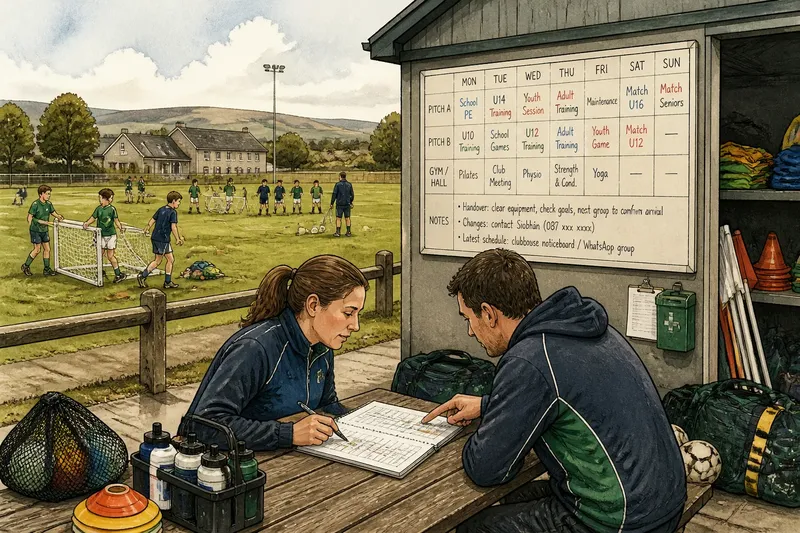
The common mistake in keeping Irish club season records is to treat a fixture list as the whole system: dates matter, but members also need to know what changed and which version is current. For clubs using paper records, notices, calendars and minutes can each answer a different question without implying that every club followed the same historical routine.
Notices made immediate changes visible
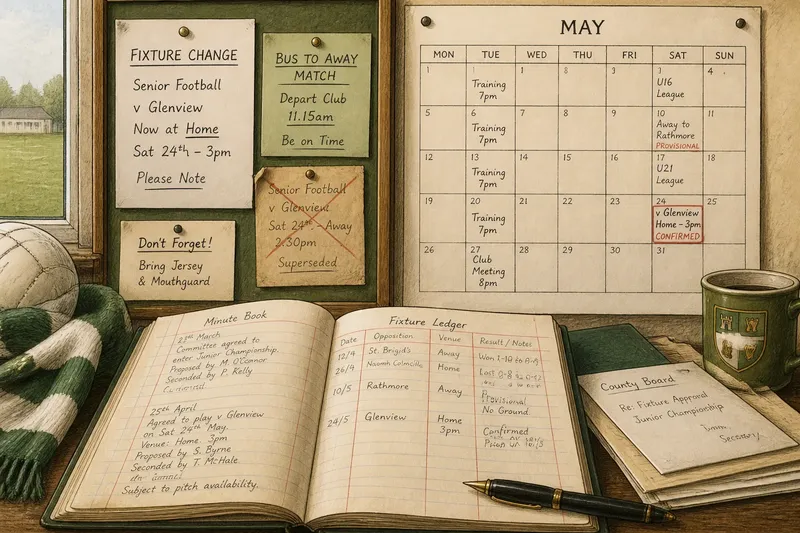
A noticeboard outside a clubhouse, a sheet in a local shop window or a printed card at training can carry urgent club business: a match venue, a meeting, a bus departure or a request to bring a jersey. A player who passes the shared notice point can see that a fixture has moved without searching through a full season plan.
That convenience has a limit. A superseded notice may remain in someone’s pocket, or an old date may continue to circulate by word of mouth. Whoever updates the notice should make the new information unmistakable, remove or mark the obsolete version, and tell people who may not see the board.
Use a notice for information that is short-lived and calls for prompt action; do not rely on it as the only record of a decision.
Calendars showed how commitments fitted together
A wall calendar or a page circulated to members can show training nights, social occasions, likely competition periods and known venue commitments in one view. That wider picture can help organisers notice clashes and help households plan around the club’s schedule.
A calendar should also make uncertainty plain. Mark a date as provisional if it depends on a draw, a ground or another club’s availability; use a clear “confirmed” label only once the arrangement is settled. Otherwise, readers may mistake a working plan for a final fixture.
Imagine a club secretary has a possible cup match date but no confirmed ground. She writes “provisional” beside the date on the wall calendar, then checks the venue with the relevant organiser. Once the ground is agreed, she changes the calendar to “confirmed” and posts the final venue on the noticeboard. Members can reserve the date first and act on the confirmed details later.
Use a calendar to see the season’s shape, but keep a separate record of why dates were changed or approved.
Minutes and ledgers preserved decisions
Minute books, fixture ledgers and correspondence can hold the less visible history behind a schedule. Minutes may record a decision to enter a competition or arrange a meeting with another club. A ledger can list opponents, venues and amendments, while letters or returned forms may clarify what was agreed with a governing body.
These records are not necessarily designed for quick reading at the gate. Their value is continuity: a later committee member can check earlier decisions instead of reconstructing them from memory. Consistent names, dates and amendment notes make that task easier; unclear entries can preserve confusion as readily as useful information.
When an arrangement may need to be checked later, record who made the decision, what was agreed and any conditions attached.
Choose the record by the question it must answer
Notices, calendars and durable records complement one another. A notice answers, “What do I need to know now?” A calendar answers, “How does this fit into the coming weeks?” Minutes or a ledger answer, “What was decided, and what happened to the plan?” A club may use all three, but each should have a clear purpose.
- Check whether the information is urgent and needs to reach people at a known local point; if it is, post a notice, but if members need it elsewhere, also contact them through the club’s usual channel.
- Check whether members must compare several dates; if they do, add the commitments to a shared calendar, but if only one immediate change matters, use a notice instead.
- Check whether someone may later need to confirm who approved an arrangement; if so, enter the decision in minutes or a ledger, but if no decision record is needed, keep the working note proportionate.
- Check whether a date depends on an unresolved venue or draw; if it does, mark it provisional, but if the arrangement is settled, label it confirmed.
- Check whether venue and team names match across the records; if they do not, standardise the wording, but if they already match, leave the entries unchanged.
- Check whether the person responsible for updates is clear; if not, assign one named officer to record amendments and update notices, but if responsibility is already clear, keep the existing handover.
The best choice depends on who needs the information, how quickly they need it and whether they will have to refer to it again. A club with one regular gathering place may favour a posted calendar and brief notices; a club arranging fixtures across several venues may also need a ledger that records amendments.
How should a club handle fixture changes?
What belongs on a club noticeboard?
Put short-lived details there, such as a revised meeting place, departure point or equipment reminder. Keep longer-term plans in a calendar or durable record so they are not mistaken for last-minute instructions.
How can members distinguish a provisional date from a confirmed fixture?
Use plain labels such as “provisional” and “confirmed”, and apply them consistently. The distinction should be clear without requiring a member to ask the organiser what a symbol means.
Why keep minutes if the calendar already shows the date?
A calendar shows the current plan, while minutes can record the decision behind it and any conditions. If a later committee needs to check who agreed to a venue or competition entry, the calendar may not provide enough detail.
What should a new secretary check in older records?
Look for recurring commitments, consistent names for venues and competitions, and notes explaining changes rather than dates alone. For current fixtures, consult the relevant governing body and venue information where applicable.
Paper records depended on a shared update routine
Paper systems work only when people can identify the current version. One officer might update a ledger, another pin up a notice, and a captain might pass on a change at training. If those actions are disconnected, members can encounter conflicting dates. A simple routine—record the amendment once, then update the calendar and notice from that record—helps keep the versions aligned.
Irish club season records are most useful when their purpose is explicit: notices for immediate action, calendars for the shared shape of time, and minutes or ledgers for decisions that need to remain accessible. Before copying a new list, decide who will update it and what members should be able to learn from it.