A Shared Field or Dedicated Ground?
Shared field or dedicated ground decisions shape training times, equipment storage and handovers; compare the practical trade-offs before setting a club routine.
The common mistake in choosing a shared field or dedicated ground is to treat the booking diary as the whole problem. A slot may look convenient on paper, yet leave players waiting for another group to clear cones or force volunteers to carry kit across town. The real cost is friction: lost preparation time, uncertain handovers and a routine that depends on everyone remembering the same unwritten rules.
For Irish clubs using school pitches, council grounds or community facilities, the useful question is not which arrangement sounds more serious. It is how each one fits the people, equipment and other activities that need the place. A dedicated ground offers continuity, but also asks a club to take responsibility for more of its upkeep and coordination. Shared use can make a facility more available to a community, while requiring clearer agreements about time and space.
Shared field or dedicated ground begins with the weekly routine
Start by writing down a representative week, rather than designing around the busiest fixture of the season. Include training sessions, matches, youth activity, grounds maintenance and the time needed to set up and put equipment away. A team’s visible playing time is only part of its occupation of a field.
On a shared field, the club’s slot is one piece of a larger timetable. A school group may finish just before training, or another club may need the same changing area. On a dedicated ground, the timetable can be more flexible, but the club still has to coordinate access among teams, coaches, grounds staff and volunteers. The difference is who manages the overlap, not whether overlap exists.
Say a fictional club has a midweek youth session followed by adult training. If it shares a pitch, it could agree a handover routine with the preceding user and keep the first activity’s equipment to one side. The observable aim would be that the youth group can begin promptly and the next team can take over without a scramble. On a dedicated ground, the same club might set an internal buffer between sessions and assign someone to check the surface and goals.
Write down the arrival time, playing time and departure time for every regular group. This makes the hidden edges of a booking visible.
Scheduling works best when handovers are explicit
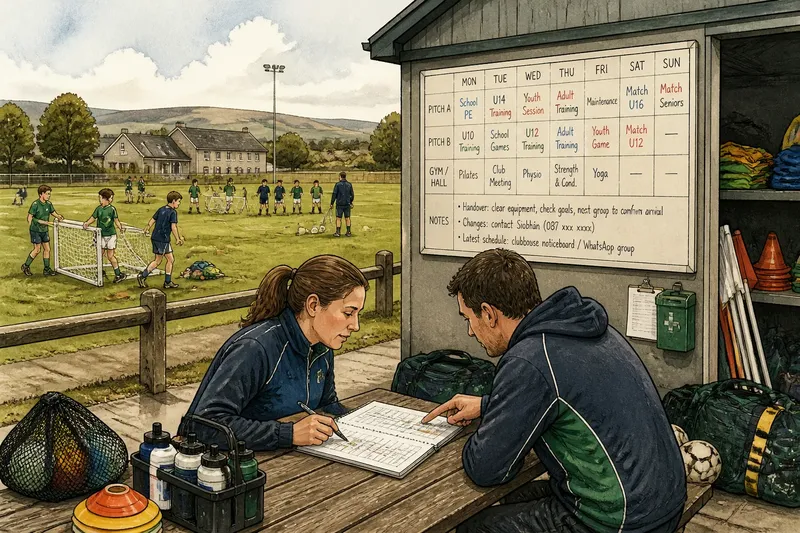
Shared facilities benefit from a calendar that names the activity, the area in use and the person responsible for the handover. A whiteboard at the clubhouse, a shared digital calendar or a simple weekly message can all work; the important point is that users can see changes before they arrive. Last-minute messages should have a clear route, rather than relying on one volunteer to pass them on informally.
Leave room for the ordinary delays of sport. A match may overrun, a session may need to move because of the surface, or a school event may affect access. Agree in advance who can approve a change and how affected groups will hear about it. A calendar that records only the desired plan will not help much when the plan shifts.
For a dedicated ground, a club may be able to move sessions around more freely, but that freedom can produce competing expectations. A youth coach might assume a goal is available; a grounds volunteer might have set aside the same area for maintenance. The club should still publish a single current schedule, with a named contact for changes and a way to flag unavailable spaces.
- Record setup and pack-away time as part of each booking.
- Name the person who confirms a handover or change.
- Mark areas that are unavailable, not merely the sessions that are happening.
- Tell users where to check for the latest version of the schedule.
Storage changes the value of a playing slot
Equipment storage often decides whether a field is practical for a club’s routine. Goals, corner flags, bibs, cones and first-aid supplies all need a known home. If a shared facility has a secure store, the users need an agreement about access, labelling and what can remain there. If it does not, the club must account for transport, collection and the time needed to return everything after a session.
A dedicated ground may allow the club to organise its own shed or equipment room, but storage still needs a system. Separate team areas, clear labels and a simple record of who holds keys can prevent kit from drifting between groups. Keep frequently used items easy to identify, and decide who checks that they are ready before a session rather than expecting every coach to search.
Storage is also a question of fairness. One group should not quietly occupy the only useful cupboard or leave bulky equipment in a route used by others. For a shared site, agree what belongs to each user and what is communal. For a dedicated site, make the same distinction across age groups and sections of the club.
What should a club compare before settling on an arrangement?
Who controls the weekly timetable?
Ask who can confirm bookings, approve changes and tell users about interruptions. Shared sites need a reliable link between organisations; a dedicated ground needs an internal process that serves every team, not just the senior side.
Where will equipment go between sessions?
Check what storage is available, who can access it and whether equipment can remain on site. If kit must travel, include the collection and return routine in the timetable rather than treating it as an informal favour.
How will groups hand the field over?
Agree what must be cleared, who checks the area and how the next group signals that it has arrived. A short, consistent handover is especially useful where sessions run close together.
What happens when a session cannot use the field?
Decide who communicates a closure or change and what alternative space, if any, can be considered. The right arrangement depends on local access and the facility’s own rules, so check the relevant agreement and instructions before setting the routine.
A weekly plan should include a fallback, not just a booking
At the start of a season, ask each team to identify its regular slot, equipment needs and likely points of contact with other users. Put those details into one shared record. During the first ordinary week, confirm that people know where to find the schedule, how to access the store and whom to contact if a handover changes.
After a few weeks, review the routine with the people who use the field at the edges of the timetable: the group arriving first, the group leaving last and anyone responsible for equipment. Ask where time is being lost and whether a change would solve the issue without moving the burden to another team. Adjust one practical detail at a time, then make the revised arrangement visible to everyone.
Shared field or dedicated ground is not a permanent verdict on a club’s ambitions. It is a choice about the work a club can coordinate and the responsibilities it is prepared to carry. A shared field may suit several groups when bookings and storage are clear; a dedicated ground may suit a club that needs more control and can sustain the added stewardship. Either way, the strongest routine is one that makes time, kit and handovers legible to the next person using the place.
When comparing a shared field or dedicated ground, look beyond the available slot: ask who will open the store, update the calendar and leave the space ready for whoever comes next.